
Constantinos Simitis
Kostas Simitis was born in Piraeus on June 23, 1936.
He studied law and economics in Germany and the United Kingdom, where he met his wife, Daphne Simiti (née Arkadiou), with whom he had two daughters, Fiona and Marilena.
He began his academic career as a Doctor of Law at the University of Marburg in 1959. After escaping from Greece during the dictatorship, he taught from 1971 to 1975 as a lecturer at the University of Konstanz and subsequently as Professor of Civil Law at the University of Giessen. In 1977, he was elected Professor at Panteion University of Athens.
In 1965, he played a leading role in the establishment of the Political Research Group "Alexandros Papanastasiou". The "Papanastasiou Group" aimed at the systematic study of the major issues facing the Greek economy and society, as well as the undertaking of initiatives for addressing them. In 1967, the group evolved into the anti-dictatorship organization "Democratic Defense".
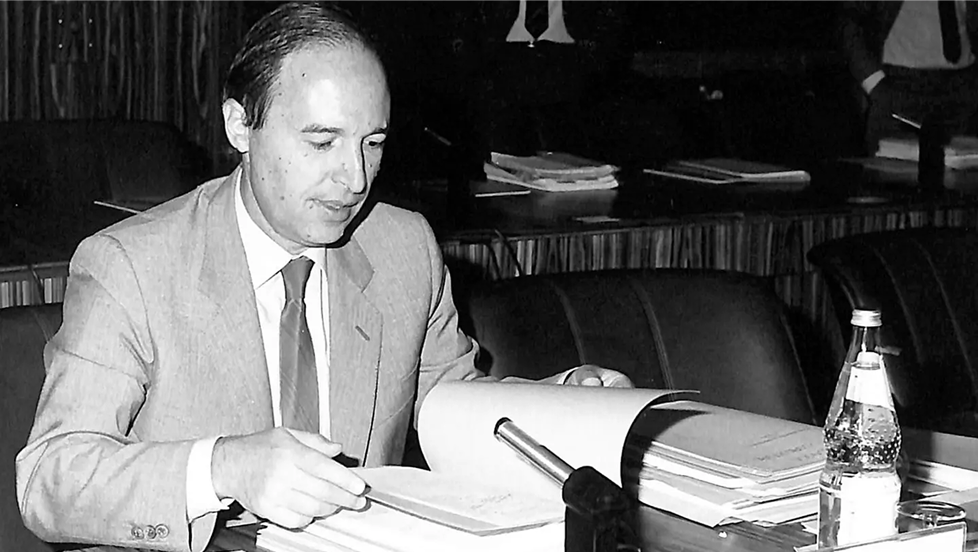
He actively participated in the anti-dictatorship struggle (1967–1974). Following the arrest of his associate Sakis Karagiorgas in 1969, he fled abroad, where he was sentenced in absentia to imprisonment. In retaliation, his wife Daphne was arrested and held in solitary confinement for two months. In 1970, while in Germany, he became a member of the Panhellenic Liberation Movement (PAK), and in 1974 he was a founding member of PASOK, contributing decisively to the drafting of the "Declaration of 3 September". He participated in both the first Executive Bureau and the first Central Committee of PASOK.
In the 1974 referendum on the monarchy (8 December 1974), he was appointed by PASOK as the spokesperson for the "NO" position in a special televised address.
In the 1977 elections, he co-drafted PASOK’s electoral program.
With his article "Structural Opposition" and his addition to the slogan "No to the Europe of Monopolies" with "Yes to the Europe of Peoples," he came into conflict with the party’s leadership core and resigned from the Executive Bureau (13 June 1979).
In the 1981 elections, despite initial commitments by Andreas Papandreou, he was not included in PASOK’s candidate lists.
Immediately after PASOK’s electoral victory in October 1981, he assumed the post of Minister of Agriculture in the first government of Andreas Papandreou.
He served as Minister of Agriculture until 1985, successfully securing the integration of Greek agriculture into the Common Agricultural Policy of the EEC, as well as a significant increase in Community subsidies.
He returned to the Executive Bureau in 1984. In the 1985 elections, he stood for Parliament for the first time, being elected as the leading MP in Piraeus, thus beginning a long parliamentary career which lasted until his retirement from active politics in 2007.
In 1985, he was appointed Minister of National Economy, where he served until November 1987, implementing the first stabilization program, which significantly reduced macroeconomic imbalances. In November 1987, he resigned in disagreement over the relaxation of economic recovery measures.
Following PASOK’s electoral defeat in 1989, he was re-elected to the Executive Bureau by the Central Committee in Anavyssos, with the mandate of "reviving PASOK".
During the Ecumenical Government of Professor Xenophon Zolotas (November 1989–February 1990), he served as Minister of National Education and Religious Affairs.
In 1990, at the Central Committee meeting in Pentelikon, Andreas Papandreou imposed the election of Akis Tsochatzopoulos as Party Secretary, against the candidacy of Paraskevas Avgerinos, supported by Simitis, Melina Mercouri, Vasso Papandreou, and Theodoros Pangalos.
From 1993 to 1995, he served as Minister of Industry, Energy, Research and Technology, and simultaneously as Minister of Commerce. During this period, he established the framework for a long-term development policy for the Greek economy. He resigned on 11 September 1995, due to the Prime Minister’s handling of matters within his portfolio without prior consultation.
Ahead of PASOK’s 3rd Congress (April 1994), he published a series of articles ("Towards a Knowledge-Intensive Economy," "Information Society: Information as a Factor of Economic Development," among others), gradually shaping his positions on "modernization."
In November 1994, Vasso Papandreou convened the "Dinner of the Four," inviting Simitis, Paraskevas Avgerinos, and Theodoros Pangalos to discuss "a way out of PASOK’s and the government’s declining trajectory."
In late November 1995, Andreas Papandreou was hospitalized at the Onassis Cardiac Surgery Center, with his health irreversibly deteriorating. Following his letter of resignation, the Parliamentary Group on 18 January 1996 elected Kostas Simitis as the new Prime Minister.
At PASOK’s 4th Congress, held after Andreas Papandreou’s death, Simitis was elected President of PASOK with 53.77% against Akis Tsochatzopoulos (46.23%).
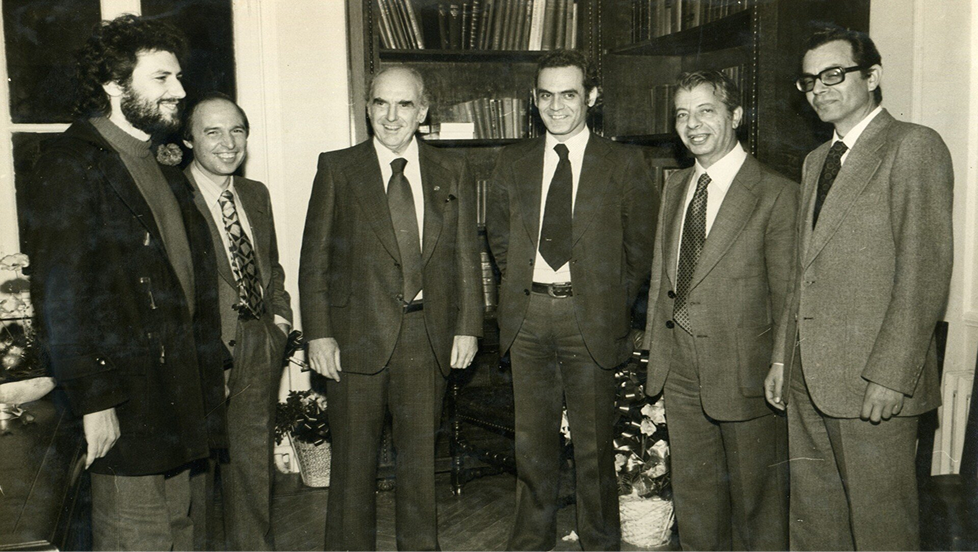
At PASOK’s 5th Congress in March 1999, he was re-elected President of PASOK. In the parliamentary elections of 9 April 2000, he was re-elected Prime Minister, with PASOK increasing its share of the vote. At PASOK’s 6th Congress in October 2001, he was elected President of the Party for a third time.
On 7 January 2004, with the aim of ensuring a smooth political succession, he announced his resignation from the presidency of PASOK, while remaining Prime Minister until the end of his second term and the parliamentary elections of 7 March 2004, completing more than eight years in office.
He was continuously elected as Member of Parliament for the First Constituency of Piraeus from 1985 onwards.
After the parliamentary elections of 7 March 2004, he participated in international fora and organizations such as the Action Committee on European Democracy (ACED), the Clinton Global Initiative, and the Interaction Council.
Following his resignation from the Ministry of National Economy in 1987, Simitis articulated the framework of his overall political thought through the publication of articles and studies. With the establishment of the "Reflection Group for the Modernization of Society" (OPEK), he created a platform for the discussion of modernization issues.
As Prime Minister, he pursued the modernization of Greek society, particularly focusing on the stabilization and growth of the Greek economy and strengthening Greece’s position within Europe and the international arena.
In 2000, under his leadership, Greece joined the Economic and Monetary Union, achieving a national strategic objective. With the replacement of the drachma by the euro, policies for real and social convergence were accelerated.
Balanced regional development was promoted through the implementation of hundreds of small and large infrastructure projects across Greece, within one of the most extensive development programs in the nation’s history.
Among these projects were the Eleftherios Venizelos Airport, the Attiki Odos, the Rio–Antirrio Bridge, the Athens Metro, and the Egnatia Odos. Equally significant was the modernization program for the welfare state, with an emphasis on expanding healthcare and social infrastructure, including the construction of dozens of hospitals nationwide.
Key milestones in his modernization efforts included economic stabilization, sustained growth, the creation of independent regulatory authorities, modernization of public administration, the "Kapodistrias Program" and decentralization of central government, the dismantling of the "17 November" terrorist organization, new identity card regulations, the construction of new museums, the unification of Athens’ archaeological sites, and the initiation of work on the Acropolis Museum. At the same time, preparations were made for the successful hosting of the 2004 Olympic Games in Athens.
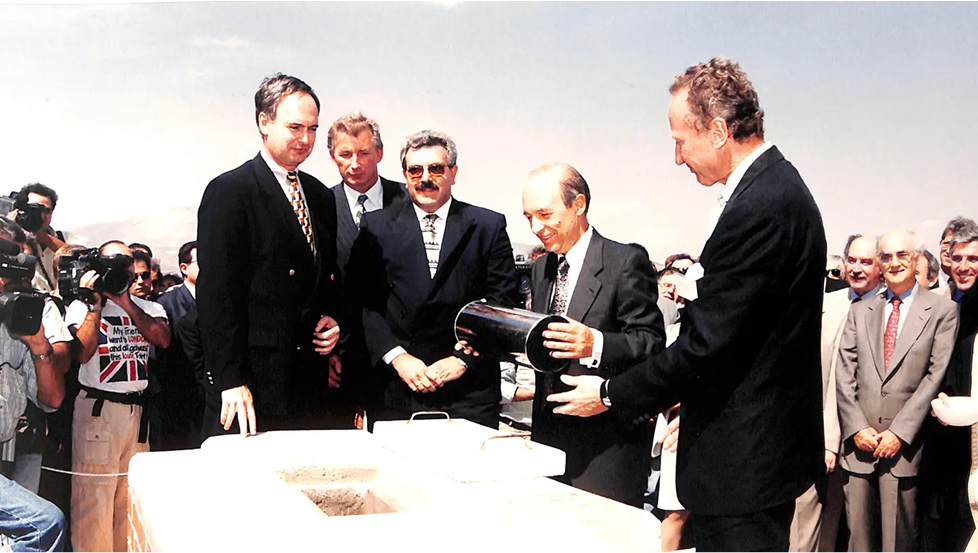
During his premiership, Greece strengthened its position within European decision- making bodies, particularly the European Union and NATO. The accession process of Cyprus was planned and completed. The "Charter of the Western Balkans" was drafted and adopted, integrating the Balkans into the European sphere. Greek–Turkish relations entered, for the first time, a phase of understanding with a view to resolving the continental shelf issue in accordance with the Helsinki Summit decisions.
As Prime Minister, he presided over the European Council during the first half of 2003. During the Greek Presidency, on 14 April 2003, at the Stoa of Attalos in Athens, the accession of ten new member states—including Cyprus—into the European Union was formally marked. At the same time, the procedures for the European Constitutional Treaty were completed. The Lisbon Strategy for growth and employment was advanced. A unified stance among EU member states was achieved in response to the crisis arising from the Iraq war.
Following the end of his premiership and as a Member of the Hellenic Parliament, he continued to intervene in public life through speeches and publications, remaining committed to his enduring goals: a strong Greece, a strong society, modernization, and European orientation.
Kostas Simitis spoke English, French, and German.
His written and public work includes political and academic texts and books.
Kostas Simitis passed away at his country residence in Agioi Theodoroi, Corinth, on January 5, 2025.